Essential Apps for Traveling in China
What I wish I had prepared before my first trip to China.

I was probably eight when China first became real to me. My parents had just returned from a work trip with a small painted box, a packet of tea I was not allowed to open, and photographs of the Great Wall fading into a pale horizon. Those things became my first impression of the country: old streets, enormous cities, fast trains, food I could not name, and places that seemed impossibly far away.
In the years that followed, I travelled elsewhere first. I took short trains through Europe, spent a humid week in Vietnam, and discovered how much I liked arriving in a new city with just enough of a plan. China never left the list; it simply remained the trip I kept putting off. Then, after a few years of work and too many postponed ideas, I finally set aside two weeks for Shanghai, Hangzhou, and Beijing. This year, I told myself, I’m actually going.
I thought I was prepared
The weeks before departure became their own small project. I read Reddit threads over breakfast, watched YouTube walking tours at night, saved restaurant videos from TikTok and Instagram, and followed recommendations other travellers had found on Xiaohongshu. My Notes app filled with cafés, museums, neighbourhoods, noodle shops, train times, screenshots, and addresses copied from guides.
There was a folder in Google Maps, a translation app, booking confirmations, airline apps, payment instructions, and a spreadsheet that made each day look satisfyingly intentional. I had chosen hotels near metro stations. I had saved a rainy-day alternative for Hangzhou. I had even made a list called “things to eat before leaving Shanghai.”
I had spent weeks planning China. I assumed the difficult part was already over.
That confidence lasted until my first evening in Shanghai.
Then I landed in China
China itself was not the problem. Pudong Airport was orderly, the metro was clear, and the city felt immediately alive rather than intimidating. The difference was quieter than that: the digital environment was not the one I had built my usual travel habits around.
That evening, I tried to find a restaurant I had saved from an Instagram post. In my Notes app it had an English name, a photo of a tiled doorway, and a vague mention of a neighbourhood. A web search returned a few promising pages. But the name did not match what I found in local maps. There were several similarly named places, more than one branch, and no Chinese address I could show a driver with confidence.
Eventually, I worked backwards: screenshot, translate, search again, compare photos, find a Chinese name, check it against the storefront. It took perhaps fifteen minutes. Nothing dramatic happened. I still ate well. But standing on a busy pavement with my phone in both hands, I finally saw the real gap.
I knew exactly where I wanted to go. I just couldn’t turn that place into somewhere I could actually reach.
The little problems started adding up
The famous places were easy enough. The Bund, Yu Garden, West Lake, the Forbidden City—these have names that travel well. The friction appeared around the places that make a trip feel personal: a tiny coffee shop from a screenshot, a local restaurant with a transliterated name, a shop inside a mall, or a recommendation sent by a friend who had copied it from someone else.
The same place could exist as an English name, a Chinese name, pinyin, an abbreviated nickname, or several pins that looked almost identical. Translation helped with words, but not always with identity. Was this the right restaurant? Was it the right branch? Was it a ten-minute walk through the mall or ten kilometres away?
Then there was the planning. I had saved more places than I could visit, which is a pleasant problem until you try to make a real day out of them. A collection of pins is not an itinerary. It does not tell you which two stops belong together, whether the museum will take an hour or three, or how long the metro connection really changes the shape of an afternoon. More than once, I realised my beautifully saved morning and afternoon were on opposite sides of the city.
And travel has a way of introducing needs that were not in a spreadsheet. A menu you want to understand. A medicine label you are unsure about. A payment prompt. The nearest restroom, pharmacy, or ATM. In those moments, I did not want to learn a whole new local search language. I wanted to understand what was in front of me and make the next sensible decision.
China wasn’t difficult. My travel workflow was.
After a few days, the pattern became clear. China was not hard to travel through in the way I had quietly feared. High-speed trains were excellent. City transport was extensive. Restaurants were everywhere. I felt safe walking, and when I was visibly lost, people were often patient enough to point me in the right direction.
The trouble was that my familiar travel workflow had been designed for a different digital ecosystem. At home, it was simple: a recommendation became a web search, then a pin, then directions. In China, a recommendation often had to pass through another layer—English name to Chinese name, name to the right point of interest, point of interest to the right branch, then into the map and onto the street.
I didn’t need more travel inspiration. I needed a better bridge between the information I already had and the places around me.
What I would prepare before traveling to China again
If I went again, I would not start by collecting twice as many guides. I would prepare a small, connected toolkit—one that covers the practical chain of a day, from paying for breakfast to finding an unfamiliar address before dinner.
Payments
Set up a China-friendly payment option before boarding. Alipay and WeChat Pay are worth preparing in advance, including the account and bank-card steps that are much nicer to complete from home. They do not make a trip less spontaneous; they make ordinary moments feel ordinary.
Communication
Bring a reliable translation tool—Google Translate, Apple Translate, or another option that supports Chinese well. It is useful for menus, signs, short questions, and the small exchanges that make a city feel closer. But translation solves language; it does not necessarily solve location identity.
Navigation and transportation
Understand the local map ecosystem before you arrive. Apple Maps can be an approachable starting point on some devices, while Amap and Baidu Maps have especially deep local place data. For getting around, have the relevant rail, flight, metro, and ride-hailing tools ready—Railway 12306, Trip.com, and DiDi are common parts of that practical layer. The point is not to install everything. It is to know which link in the journey each tool covers.
My China travel toolkit
Pay
Set up Alipay or WeChat Pay before you land.
Communicate
Keep a translation tool ready for the moments in front of you.
Move
Have rail, ride-hailing, and local map tools within reach.
Explore
Turn saved ideas into places and a day you can follow.
The missing layer
Looking back, I had payment solutions, transport solutions, translation solutions, and maps. What I did not have was a way to join them together when the starting point was messy human information: a Reddit recommendation, a TikTok screenshot, an English restaurant name from a friend, or a paragraph copied from a guide.
How does that become the correct Chinese place, a confirmed point of interest, usable coordinates, a workable route, and somewhere you can actually navigate to? That is the gap GowhereAI was made to address.
Why should finding a place become harder just because the recommendation and the map speak different languages?
What GowhereAI actually helps with
GowhereAI is not a replacement for the tools travellers already use. It is a travel assistant for the space between discovering something and acting on it in China.
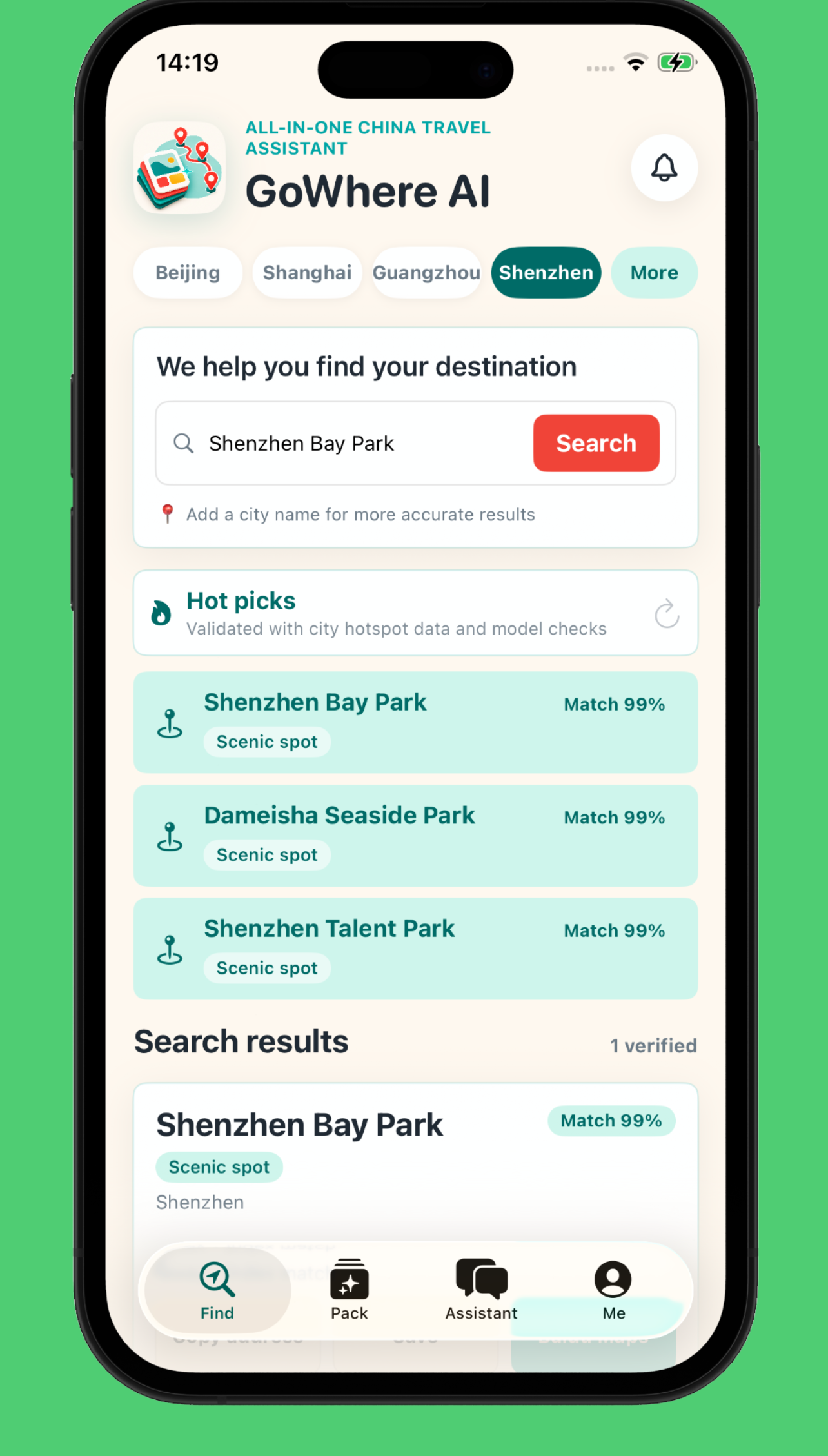
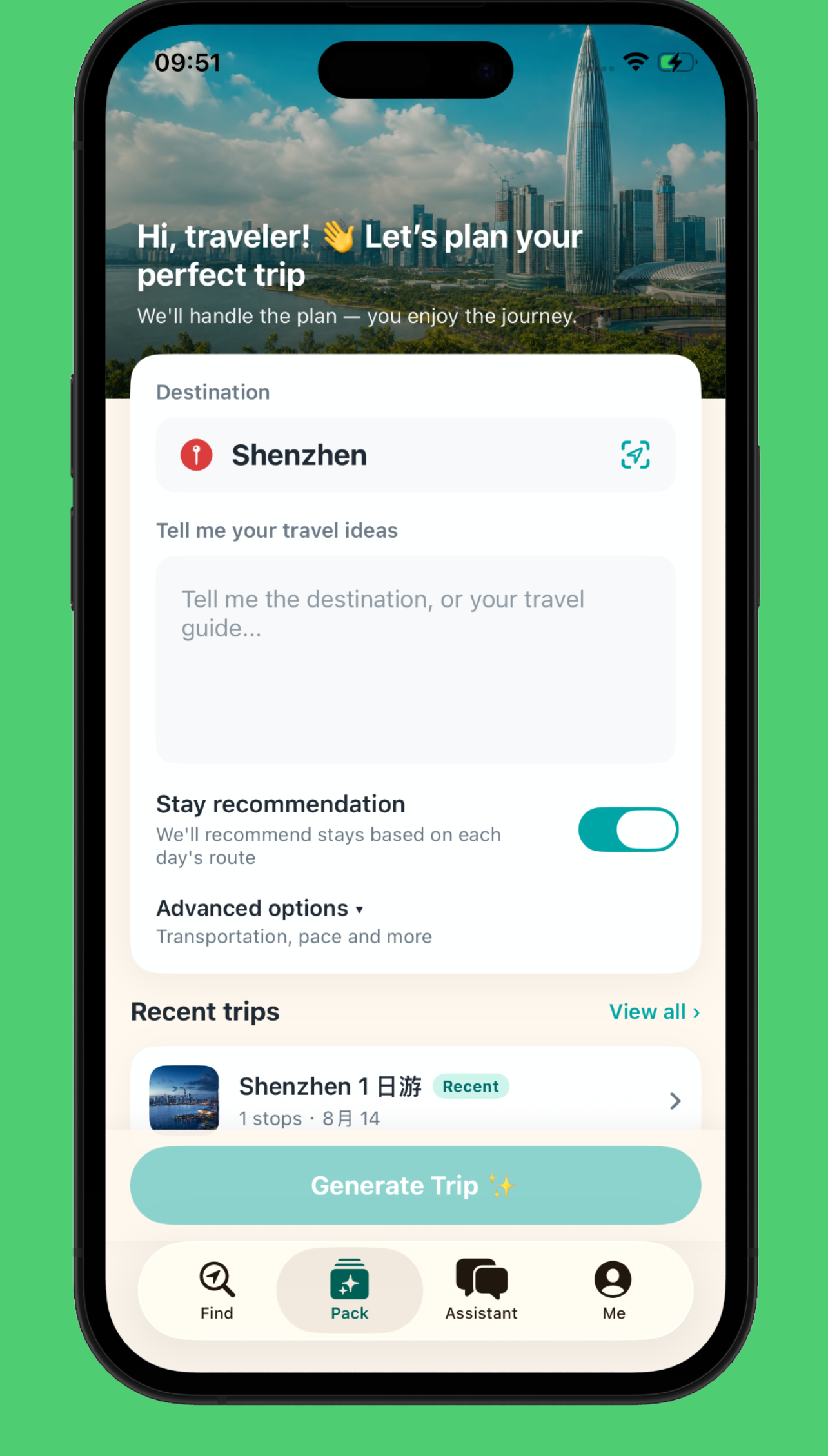
It helps travellers search Chinese places using English, Chinese, pinyin, and other supported languages—not simply by translating a phrase, but by aiming for the real location behind it. It can turn screenshots, social posts, and scattered travel notes into places you can organise. From there, it can help shape several stops into a day that makes geographic sense rather than a list that only looked good on a Sunday evening at home.
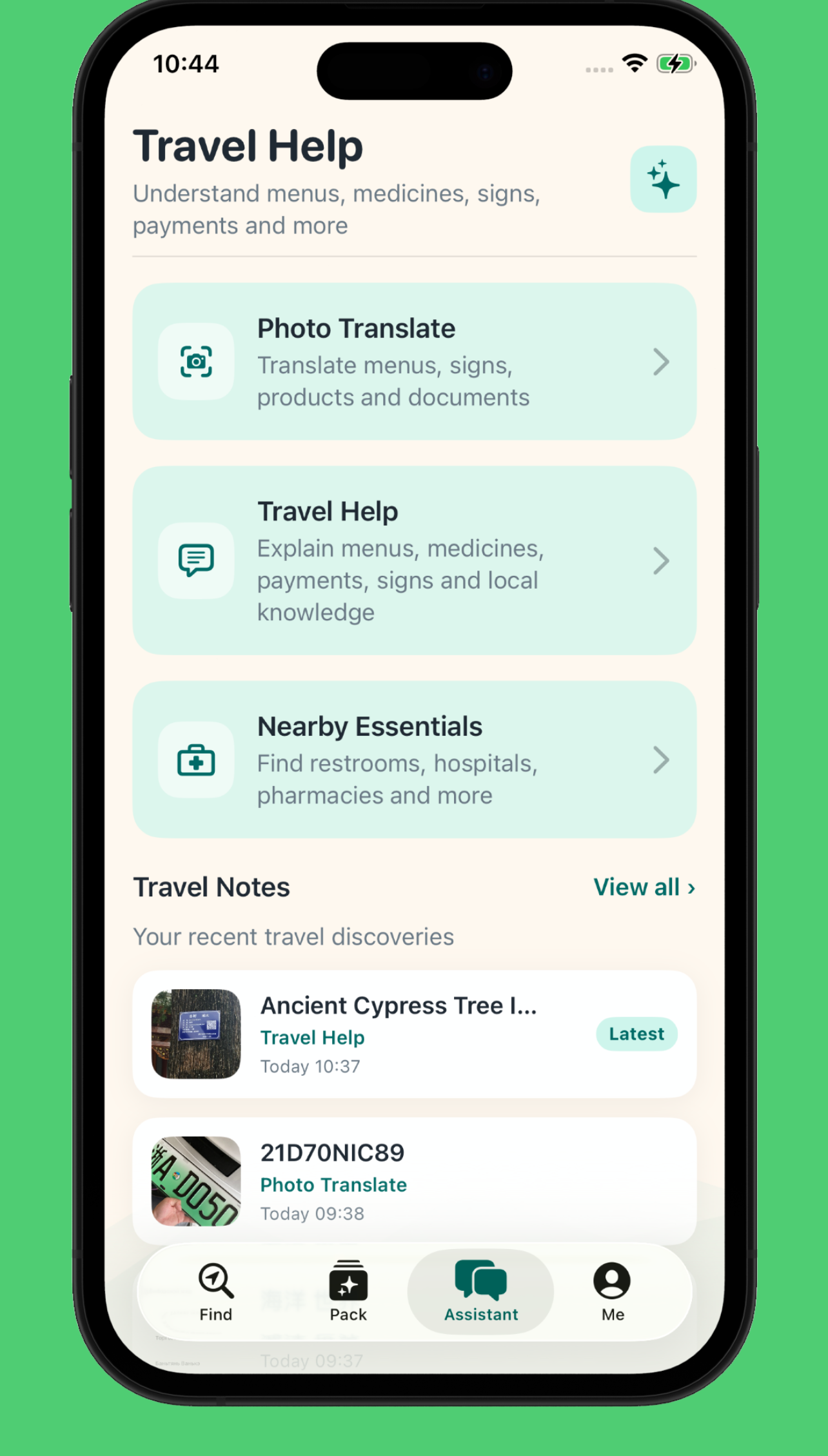
It also supports the practical context of a trip: understanding food, medicine, local services, and everyday questions; finding essentials such as hospitals, pharmacies, restrooms, and ATMs when you need them. The ambition is deliberately modest. Not to make travel automatic—just to remove the avoidable pauses that interrupt it.
The trip I would take differently
If I returned to Shanghai, Hangzhou, and Beijing, I would not make a stricter itinerary. I would probably make a looser one. I would keep less in screenshots and trust that a good idea could become a real place when I needed it to. I would leave more room for the turn down a side street, the café that was not on the list, the meal whose name I had never learned to pronounce.
I think about Shanghai after dark, when the signs seemed to change character every few blocks; an early walk beside West Lake before the crowds gathered; the quiet scale of a Beijing hutong after the noise of a main road. I remember the high-speed train window, a small restaurant where I ordered by pointing and smiling, and the relief of realising I did not need to control every detail to enjoy the day.
The right technology should make more of those moments possible, then step back into the background.

For your first trip to China
China is much easier and more rewarding to travel through than many first-time visitors expect. It helps to arrive knowing that the payment ecosystem, map ecosystem, language environment, and local services work differently from the ones you may know at home. Once you have the right tools in place, the country opens up with remarkable ease.
Do not spend every spare hour trying to create the perfect itinerary. Leave some space. Change your mind. Go into the shop you did not save. Take the metro to a neighbourhood because it looks interesting. The purpose of preparing is not to eliminate surprise. It is to make surprise feel possible.
Why we built GowhereAI
We built GowhereAI because the frustrations above are small in isolation. Finding one Chinese address is not a major problem. Translating one menu is not a major problem. Rearranging one day’s plan is not a major problem.
But during a two-week journey, those moments accumulate. They quietly take attention away from the reason you travelled in the first place. Travel software should help you spend less time managing the trip—and more time experiencing it. That is what we hope GowhereAI can do for more people travelling through China.
Traveling to China?
GowhereAI helps international travellers find the right places, turn travel notes into usable itineraries, understand local information, and navigate China with less friction.